
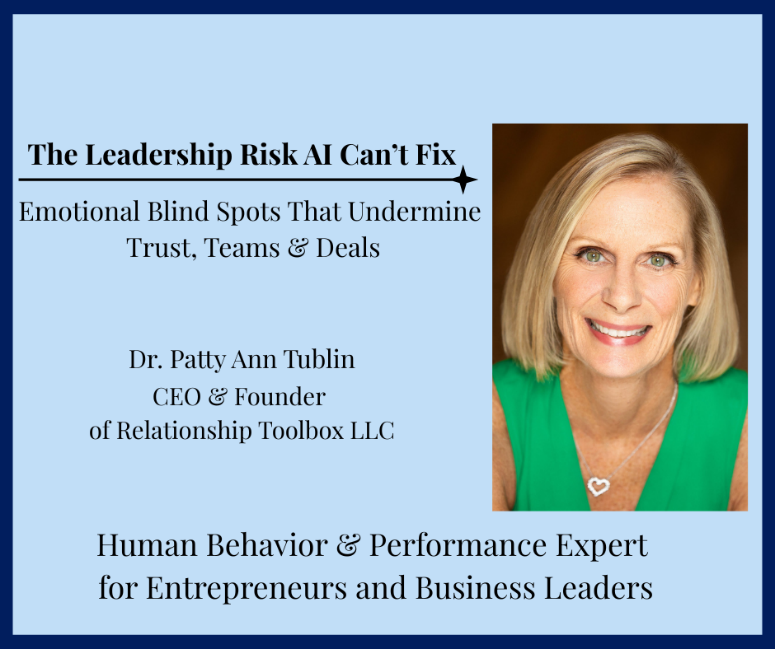
The Leadership Risk AI Can’t Fix: Emotional Blind Spots That Undermine Trust, Teams, and Deals
You can be smart. Experienced. Even highly successful.
And still be the biggest risk to your own leadership.
One of the most damaging threats to trust, team performance, and deal flow isn’t strategy, skill, or even market conditions—it’s emotional blind spots.
In an era where AI can analyze data, optimize workflows, and predict outcomes, there’s one thing it still can’t do for you: help you see yourself clearly.
And that’s where leaders get into trouble.
What Emotional Blind Spots Really Are
An emotional blind spot is a behavior, reaction, or belief you don’t recognize in yourself—but everyone else experiences.
It’s how you show up under pressure.
How you react to feedback.
How safe—or unsafe—others feel being honest with you.
You might think you’re being “direct,” while others experience you as dismissive.
You might believe you’re “staying professional,” while your team experiences emotional distance.
You might pride yourself on being decisive, while clients quietly feel steamrolled.
These blind spots aren’t character flaws. They’re outdated survival strategies—learned responses that once protected you but now quietly sabotage trust.
And unlike technical gaps, AI won’t flag them for you.
Why Emotional Blind Spots Matter More in the Age of AI
As AI takes over more analytical and operational tasks, leadership is becoming less about what you know and more about how you relate.
Here’s what I see consistently with executives and founders:
- Teams won’t fully adopt AI tools when they don’t trust the leader rolling them out.
- Innovation stalls when people are afraid to challenge assumptions or speak up.
- Deals fall apart not because of numbers—but because of tone, timing, or emotional misreads.
AI accelerates execution.
But emotional blind spots quietly sabotage it.
How to Start Seeing What You’ve Been Missing
You can’t fix what you can’t see—but you can learn where to look.
- Follow the Patterns, Not the Stories
If the same issues keep showing up—with employees, clients, or partners—it’s not coincidence.
Ask yourself:
- Where do I consistently feel misunderstood or frustrated?
- What feedback do I tend to dismiss or rationalize?
- What complaints seem to follow me across roles or teams?
Patterns don’t lie. They point directly to blind spots.
- Invite Real Feedback—and Don’t Defend
Most leaders ask for feedback in ways that feel safe—but unhelpful.
Instead, ask:
- What’s it like to work with me when I’m under pressure?
- How do I handle conflict, really?
- Where might I be getting in my own way?
Then do the hardest part: listen without explaining.
The feedback that triggers you is often the most valuable.
- Pay Attention to Your Triggers
Blind spots surface fastest in emotional reactions—defensiveness, shutdowns, impatience, control.
When you feel triggered, pause and ask:
- What story am I telling myself right now?
- What am I protecting?
- Am I reacting to this moment—or something old?
AI can detect patterns in data.
Self-aware leaders learn to detect patterns in themselves.
Turning Awareness into Real Change
Insight without action doesn’t build trust. Here’s what does.
Own it—out loud.
Naming your blind spot disarms it.
“I’ve noticed I shut down when I feel criticized. I see how that’s limited open dialogue. I’m working on it.”
That kind of ownership builds credibility faster than perfection ever will.
Practice progress, not perfection.
Change happens through small, intentional shifts:
- Listen without interrupting.
- Pause before responding.
- Ask one more question than feels necessary.
Repair quickly.
You will slip. That’s human.
What matters is how quickly you circle back, acknowledge it, and repair the relationship.
Trust isn’t built by never getting it wrong—it’s built by handling it well when you do.
Final Thought
Your emotional blind spots aren’t weaknesses.
They’re simply places where awareness hasn’t caught up with responsibility yet.
In a world increasingly driven by AI, your ability to lead with emotional clarity, self-awareness, and trust is no longer a “soft skill.”
It’s a competitive advantage.
If you’re ready to identify what you can’t see—and lead at a higher level because of it—that’s the work I do every day.
