
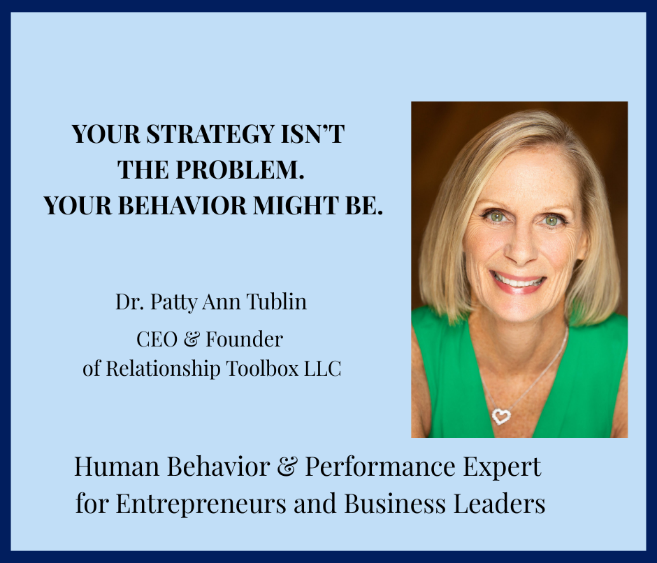
Your Strategy Isn’t the Problem. Your Behavior Might Be.
If growth has slowed, your first instinct is to revisit strategy.
New market. New hire. New system. New AI tool.
But after working with high-performing entrepreneurs and executive teams for decades, I can tell you this:
Most growth stalls aren’t strategic.
They’re behavioral.
And behavior is harder to see.
As a human behavior and human performance coach and consultant — I focus on the invisible dynamics that directly affect measurable results.
Revenue is driven by people.
People are driven by trust, communication, clarity, and emotional stability at the top.
When those are strong, businesses scale.
When they’re not, friction quietly takes over.
Here are three behavioral risks I see repeatedly in scaling organizations.
- Emotional Reactivity at the Top
Pressure doesn’t build character. It reveals it.
When stress rises, does the leader:
- Get short?
- Become unpredictable?
- Shut down?
- Change direction without explanation?
Even subtle emotional volatility creates instability.
The team won’t say it directly — but they feel it.
And when they feel it, they adjust:
- They withhold feedback.
- They avoid candor.
- They become cautious instead of creative.
Execution slows.
Emotional intelligence isn’t about being warm.
It’s about being regulated.
Composure builds confidence.
Confidence builds momentum.
If you want a steady organization, start with steady leadership behavior.
- Communication That Feels Clear — But Isn’t
Most leaders believe they communicate well.
But clarity isn’t what you say.
It’s what others understand — and act on.
Growth stalls when:
- Expectations are implied instead of defined.
- Accountability depends on mood.
- Feedback is softened to avoid discomfort.
- Hard conversations are delayed.
As organizations grow, informal communication stops working.
Precision becomes essential.
The higher you rise, the less people challenge you directly. That makes misalignment harder to detect — and more dangerous.
Communication discipline is a performance multiplier.
When expectations are clear, ownership increases.
When ownership increases, performance accelerates.
- Trust Erosion at the Executive Level
Trust rarely collapses dramatically.
It erodes quietly.
A commitment missed.
A conversation avoided.
A leader who says one thing publicly and something different privately.
High-trust teams:
- Challenge each other directly.
- Recover quickly from mistakes.
- Move fast.
Low-trust teams:
- Manage politics.
- Over-document to protect themselves.
- Spend energy on positioning instead of progress.
Trust is not a cultural slogan.
It’s a behavioral pattern.
And when trust weakens at the top, the entire organization feels it.
Why This Matters Even More Now
AI is accelerating operational speed.
But speed magnifies whatever already exists.
If alignment is strong, technology amplifies performance.
If leadership behavior is inconsistent, technology amplifies dysfunction.
AI cannot regulate emotion in a tense executive meeting.
It cannot repair a fractured partnership.
It cannot build long-term relational equity.
That requires human discipline.
Relational intelligence.
Emotional intelligence.
Communication mastery.
The Bottom Line
Strategy sets direction.
Behavior determines execution.
If growth has stalled, before rewriting the plan — examine the leader.
Because the most expensive risks in your organization are rarely on a spreadsheet.
They’re in the room – and they may be looking back at you in the mirror!
