
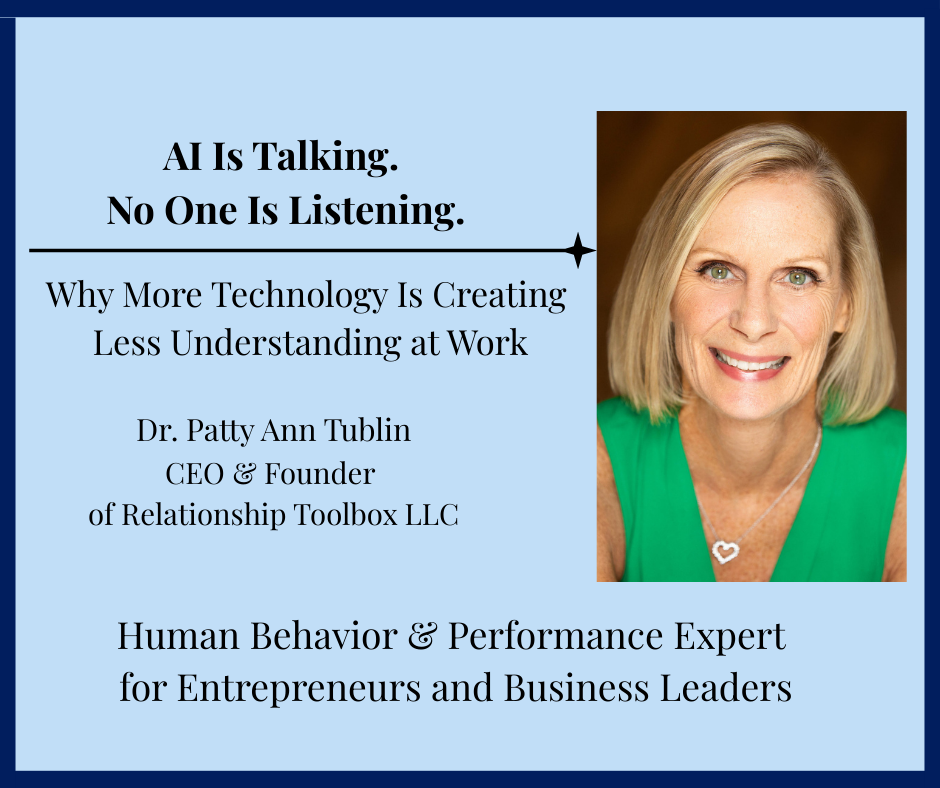
AI is Talking. No One is Listening: Why More Technology Is Creating Less Understanding
We’ve never had more information at our fingertips.
Dashboards.
AI summaries.
Automated reports.
Instant analysis.
And yet — I’m seeing more misalignment inside organizations than ever before.
More tension.
More confusion.
More “That’s not what I meant.”
AI is improving information flow.
But information is not the same thing as understanding.
And that’s where leaders are getting into trouble.
AI Can Generate Insight. It Cannot Create Meaning.
AI can summarize a meeting.
It can analyze trends.
It can draft an email in seconds.
What it cannot do is interpret emotional tone, organizational history, unspoken tension, or relational nuance.
And those things?
They determine whether a message lands — or backfires.
I’ve watched leaders forward AI-generated summaries assuming they’ve communicated clearly. From their perspective, the message is concise and accurate.
But clarity on paper does not equal alignment in people.
Without context, tone, and intentional framing, AI-generated communication can feel cold, abrupt, or misaligned with reality.
And when people feel misunderstood, trust erodes quietly.
The Dangerous Assumption: “If It’s Clear, It’s Understood.”
This is one of the biggest communication mistakes I see.
Leaders assume that because the information is accurate and structured, it will automatically be understood the way they intend.
It won’t.
People don’t process information purely logically. They process it emotionally first.
What does this mean for me?
Am I safe?
Am I valued?
Is this a threat?
Is this a criticism?
AI doesn’t answer those questions.
Leaders do.
If you send out a beautifully structured AI-generated performance update without acknowledging the human impact, people will fill in the emotional blanks themselves.
And they often fill them in wrong.
Technology Is Neutral. Tone Is Not.
AI-mediated communication removes some of the natural human cues that help people feel connected.
Facial expression.
Voice inflection.
Body language.
Pause.
When communication is mediated through technology — especially AI-generated messaging — the leader’s responsibility actually increases.
You must ask:
- What emotional tone does this carry?
- How might this land for different personality styles?
- Where might there be ambiguity?
- Does this message build trust — or just transmit information?
Because if the tone feels transactional, people disengage.
If the tone feels dismissive, they resist.
If the tone feels impersonal, trust weakens.
AI may draft the message
But only you are responsible for how it lands.
Leaders Must Translate AI Outputs into Human Meaning
Here’s the real leadership skill in an AI-driven workplace:
Translation.
AI provides data.
Leaders provide interpretation.
AI identifies trends.
Leaders explain what those trends mean for people.
AI suggests efficiency.
Leaders ensure dignity, clarity, and alignment.
If you simply present AI findings without framing them in human terms — without empathy, context, and dialogue — you create compliance at best. Confusion at worst.
Alignment doesn’t come from information.
It comes from conversation.
The Bottom Line
AI can deliver information faster than ever before.
But information alone does not create trust.
It does not create buy-in.
And it does not create alignment.
Only humans do that.
In an AI-driven workplace, communication is not about transmitting more data.
It’s about ensuring that data is understood, contextualized, and delivered in a way that strengthens relationships rather than weakens them.
Because at the end of the day
AI can deliver information.
But only leaders create understanding.
And understanding is what drives performance.
