
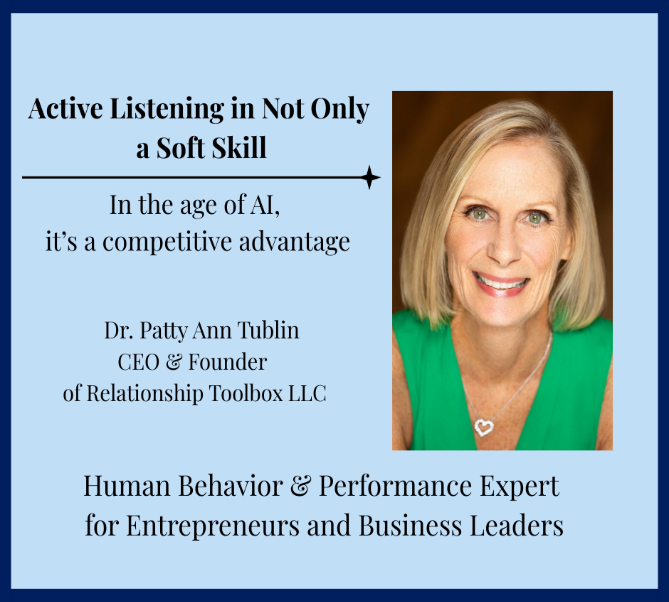
Active Listening in the
Age of AI: Why the Most Human Skill Is Becoming the Most Valuable
Most
leaders think active listening means nodding, staying quiet, and waiting for
their turn to talk.
It
doesn’t.
In
today’s workplace—where AI can summarize meetings, draft emails, and analyze
sentiment in seconds—the leaders who stand out aren’t the ones who speak the
most clearly.
They’re
the ones who listen the best.
AI is
changing how work gets done. It’s accelerating decision-making, automating
tasks, and reshaping roles across organizations. But it hasn’t changed one
fundamental truth about leadership:
People
still want to feel heard.
And when
people don’t feel heard, trust erodes. When trust erodes, performance
follows—no matter how advanced the tools are.
Where AI Helps—and Where Leadership Still Matters
AI is
excellent at capturing information.
It can:
- Record what was said
- Identify patterns
- Flag sentiment
What it
cannot do is create psychological safety.
AI can’t
sense hesitation in someone’s voice.
It can’t notice when a team member goes quiet because they don’t feel safe
speaking up.
And it can’t replace the judgment required to respond with empathy instead of
efficiency.
That
work still belongs to leaders.
As
Stephen R. Covey famously said:
“Seek first to understand, then to be understood.”
In an
AI-driven workplace, that principle isn’t outdated—it’s amplified.
Why Active Listening Is Now a Leadership Advantage
As
technology speeds everything up, human behavior becomes the constraint.
I see
this every day:
- Teams with sophisticated tools
but low trust
- Leaders with data, but little
real buy-in
- Client conversations that are
efficient, yet leave relationships weaker
Active
listening changes the dynamic.
It:
- Builds trust in uncertain
environments
- Improves innovation by creating
safety
- Strengthens collaboration across
silos
- Increases customer loyalty when
automation falls short
Active
listening isn’t soft.
It’s a performance skill.
What Active Listening Looks Like at Work
This
isn’t theoretical. It shows up in everyday business moments:
- Meetings where leaders listen to
understand—not to respond
- Conflict conversations where
emotions are acknowledged, not avoided
- Client discussions where tone
matters as much as timelines
- Performance conversations where
people feel seen, not judged
It
matters even more now—in hybrid teams, remote work, and AI-supported
environments—where presence is easy to lose.
Hearing vs. Listening
AI can
capture what was said.
Leaders
have to understand what was meant.
That
means:
- Paying attention to what’s not being
said
- Noticing shifts in energy
- Resisting the urge to fix things
too quickly
Listening
isn’t passive.
It’s intentional.
How Leaders Practice Active Listening
The
leaders who do this well aren’t flashy. They’re disciplined.
They:
- Minimize distractions (even
“helpful” ones)
- Don’t interrupt to sound smart
- Ask open-ended questions
- Reflect back what they heard
before responding
- Stay curious when it would be
easier to get defensive
None of
this is complicated.
But it does require presence—and that’s what most people skip.
The ROI of Listening
Leaders
who listen create commitment.
Teams that listen collaborate better.
Organizations that listen adapt faster.
Active
listening is one of the few skills that becomes more valuable as
AI becomes more powerful.
If you want better results, start there.
